
GHK-Cu: Copper Peptide Mechanisms in Tissue Remodeling
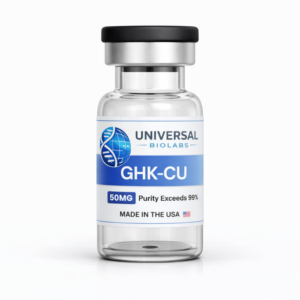
Most peptides get overhyped before the research catches up. GHK-Cu is the exception — it’s been studied for decades, and the data holds up.
This naturally occurring copper-binding tripeptide has documented effects on wound healing, collagen synthesis, inflammation, and skin health that go well beyond standard anti-aging marketing. Your doctor has probably never mentioned it. That’s not because it doesn’t work — it’s because there’s no patent, no pharmaceutical monopoly, and no financial incentive for the medical establishment to educate you about it.
This article breaks down what GHK-Cu actually does at the cellular level, what injectable use can realistically deliver, and what the research says about safety. No Reddit speculation. No supplement propaganda.
What Is GHK-Cu?
GHK-Cu (glycyl-L-histidyl-L-lysine copper) is a tripeptide that naturally binds copper ions and circulates in blood, saliva, and urine. Levels decline sharply with age — from roughly 200 ng/mL in young adults to around 80 ng/mL by age 60.
That drop matters because GHK-Cu functions as a signaling molecule. It:
- Activates tissue repair pathways
- Stimulates collagen and glycosaminoglycan synthesis
- Promotes angiogenesis
- Modulates inflammation via NF-κB suppression
When endogenous levels fall, regenerative capacity falls with them. Injectable GHK-Cu aims to restore that youthful systemic signaling — something topical formulations can support, but not at the concentrations achieved via injection.
The Research-Backed Benefits
Most high-quality data comes from animal and in vitro studies. Direct human injection trials are limited. That said, the mechanisms are well-established, preclinical outcomes have been remarkably consistent, and case reports from independent experimental use have been favorable with few reported adverse effects.
Wound Healing and Tissue Repair
This is where GHK-Cu has the most robust evidence. Animal models show accelerated healing across skin, lung, bone, liver, and gastric tissue — with some models showing up to 9-fold increases in collagen production.
The key mechanisms driving this:
- Fibroblast activation
- Suppression of collagen-degrading enzymes
- Reduced inflammatory cytokines
- Enhanced granulation tissue formation
- Improved angiogenesis
In ischemic wound models, injectable GHK-Cu restored fibroblast function and significantly accelerated skin repair compared to controls. It also pairs well with other healing peptides for stacked injury recovery protocols.
Skin Health and Anti-Aging
GHK-Cu is better described as a remodeler than a healer when it comes to skin. Studies document measurable improvements in elasticity, thickness, density, firmness, and smoothness — alongside reductions in fine lines and wrinkles.
The mechanism is straightforward: more collagen and elastin production, combined with antioxidant protection against the oxidative damage that degrades structural proteins over time.
Anti-Inflammatory and Antioxidant Effects
GHK-Cu demonstrates potent anti-inflammatory activity across multiple cell and animal models. It suppresses NF-κB signaling (including p65 activation) and downstream cytokines like IL-6 and TNF-α, while simultaneously reducing reactive oxygen species.
It also upregulates antioxidant defenses including SOD and glutathione. For anyone dealing with chronic low-grade inflammation — which is essentially everyone past mid-adulthood — this systemic effect may be more clinically valuable than any cosmetic benefit.
Hair Growth
Hair loss is an underappreciated application for GHK-Cu. Preclinical and early cosmetic research suggests copper peptide complexes can improve the scalp microenvironment in androgenetic alopecia through better microcirculation around the follicle, reduced inflammatory signaling, and measurable increases in hair count and shaft thickness.
It is not as aggressive as finasteride or dutasteride. But unlike 5-alpha-reductase inhibitors, GHK-Cu does not suppress DHT or compromise sexual function — making it a viable adjunct for anyone optimizing both skin and hair health simultaneously.
Additional Systemic Effects
Animal research also points to potential benefits for lung protection in injury models, DNA repair signaling, gut barrier integrity, and anxiolytic and analgesic effects. These are less conclusively established in humans, but they are biologically plausible based on GHK-Cu’s known signaling pathways.
What to Actually Expect
Injectable GHK-Cu provides systemic distribution that topical products simply cannot match — enabling deep tissue penetration, immune modulation, and whole-body collagen remodeling. What you should not expect is an overnight transformation. A realistic picture over 4–12 weeks of consistent use:
- Improved skin elasticity and firmness
- Faster recovery from minor injuries and training
- Reduced joint discomfort
- Gradual improvements in hair quality and skin texture
The effects are cumulative, not dramatic. Anyone promising instant results is either lying or selling contaminated product, possibly both.
Safety: What the Data Shows
Available experimental data describes GHK-Cu as non-cytotoxic and well-tolerated in both cell and animal studies. No significant adverse effects have been reported at typical research doses. Topical human trials and systemic animal studies show an excellent tolerability profile with no documented toxicity.
What we know from the available data:
- No reported toxicity in preclinical injection studies
- No behavioral or pathological abnormalities observed
- No adverse safety signals in topical skincare studies
- Theoretical concerns about copper overload exist, but no study to date has demonstrated this outcome with GHK-Cu
Honest Limitations
Long-term human injection data remains sparse. Most human studies focus on topical application. What we lack are prospective trials spanning decades with large patient populations. That absence doesn’t imply danger — it means we simply don’t have the longitudinal data yet.
Individuals with Wilson’s disease or copper metabolism disorders should exercise extreme caution. And sourcing matters significantly — poor manufacturing introduces risks that have nothing to do with the peptide itself.
The Bottom Line
GHK-Cu is precisely the kind of compound the mainstream medical system has no interest in promoting. It can’t be patented. It promotes individual autonomy over health outcomes. Neither of those things changes the quality of the underlying science.
The mechanistic foundation is sound. The preclinical evidence is strong and consistent. The safety profile is favorable. What’s missing is Big Pharma funding — and that will never arrive for a molecule this old and this unpatentable.
That doesn’t invalidate anything you’ve read here. It just means you need to be informed, source carefully, and approach this with appropriate responsibility.
For tissue repair, chronic inflammation, and meaningful anti-aging beyond surface-level marketing, GHK-Cu deserves serious consideration.